How (and how not) to write a DJ bio

Here's an expert guide to nailing the tone, form, and content of the most important piece of text you'll ever produce as a DJ.

Listen to this article, written by Bridge contributor Will Lynch 

Along with social media accounts, online mixes, and press pics, the DJ bio is a cornerstone of your online presence, and a necessary asset for anyone trying to build a DJ career. It’s worth noting, though, that the term “DJ bio” is a bit of a misnomer. The goal isn’t to tell your life story, in the literal sense of the word “biography. It’s to pitch you as a DJ, quickly and effectively, to whoever is checking you out. 

The DJ bio is, for the most part, a utilitarian document—people don’t exactly read these things for fun. But like any piece of writing, it needs to be clear, informative, and compelling. You need to keep the attention of your audience, remain in their memory later on, and, hopefully, sound so intriguing that they want to hear you play. 

It’s easy to write an OK DJ bio, and surprisingly challenging to write a really good one. Of all the tasks involved in getting work as a DJ, this one may feel like more of a chore than the others. The role it plays may seem relatively minor. But the DJ bio is sometimes the first point of contact between you and a potentially important part of your audience, most notably industry professionals whose impression of you could have a very real effect on your fortunes, from whether you get a particular gig, to whether or not you’re right for their booking agency. It pays off to do it well, get something that does justice to you as an artist, and that you’re personally proud to share with others.

Spoiler alert: we’re ultimately going to recommend you consult a professional writer, either to write your bio completely or edit something you’ve drummed up on your own. But whatever path you ultimately take, it’s important to know the following basics of what makes a good DJ bio.  


Think of your reader

Who will be reading this text, and why? What info will they be looking for? Where exactly will the bio appear?

The answers to these questions should guide the decisions you make about the tone, length and content of your DJ bio. Whether you’re a gigging DJ with a booking agent or a beginner just now building their online presence, certain things will always be true. Your audience is someone who, for whatever reason, has heard about you and wants to know more. Maybe it’s a club promoter pondering whether to book you. Maybe it’s a punter idly reading about the lineup for a gig you’re playing. Either way, you’ll want to assume they know nothing (or next to nothing) about you but are interested enough to have arrived at this text, and go from there. 

In practice, that means giving them the most essential info you can about you as a DJ, briefly, effectively, and, when appropriate, with a bit of style. Tell them who you are in a way they’re likely to enjoy in the moment and remember later on.  

Lead with the facts

Your bio will inevitably include some purely descriptive language, especially when you’re talking about your sound. But the more you can lead with concrete facts, the better. It’s all well and good to say you boldly navigate new forms of subfrequencies hurtling off the hardcore continuum. It would be better to present facts that lead the reader to this conclusion on their own. If you’re a drum & bass DJ, name the drum & bass events you’ve played, or the podcasts you’ve done mixes for. If you’ve released music, say which labels. If that music was played by any DJs of note, say who. 

Most of the time, hard facts like these will paint a clearer picture than flowery descriptions ever could. Writers, and more often editors and professionals, sometimes boil this idea down to the phrase “show, don’t tell.” You’re free to simply tell us what kind of DJ you are (or intend to be).  But it’s more effective to present neatly organized information that lets us arrive at that impression on our own. 

If you’re too early in your journey to have these kinds of credentials, balance descriptions of your sound with references to your inspirations and influences, focussing on names the reader is likely to know. In the days of yore (i.e. the 2000s), promos sent to journalists often finished with a section titled RIYL—”review if you like”—which would rattle off a list of well-known artists in the same sonic ballpark as the record they were pushing. It might feel either cringe or presumptuous to bracket yourself with household names. But you can orient the reader quickly and effectively by naming a few seminal artists who helped shape your sound. 

Pitch yourself

The ultimate goal of the DJ bio is to, in some way, directly or indirectly, push your career as a DJ forward. This means finding a simple and effective way to pitch yourself, ideally one that is accurate, compelling, and that you can fully get behind (in other words, that doesn’t make you wince to reread). This part can be hard to get right. Hype yourself up too much and you’ll seem cocky. Be too modest and you’ll fail to hold your reader’s attention. The key is to write and revise your text until you find a middle ground: intriguing and impressive, but relatable and plausible. 

As you ponder this part of the bio, start by answering this question: what makes you special as a DJ? In other words, what makes you different from all the others? And why should the reader go out of their way to check you out? 

In their classic book How To DJ (Properly), Bill Brewster and Frank Broughton emphasize again and again one simple piece of advice: lean into whatever it is about your style that makes you unique. At every gig, their theory goes, you want to prioritize the records that only you would play. This will make your set more interesting for the crowd, and make it more likely that you’ll stand out in their memory later on. 

The same logic applies here. Identify what makes you different from everyone else, and make it the centerpiece of your bio, beginning with the first sentence (more on that later).

It’s perfectly normal if you’re not sure exactly what your special sauce is, or how to describe it. Many artists have trouble observing themselves in this way, which is why it can be handy to have someone else write your bio—it may be easier for that person to articulate what makes you interesting as a DJ than it is for you. 

If you’re struggling to figure this out and put it into words, start by picturing your fantasy DJ set. Think about what the scene looks like. Is it a heaving dance floor in a packed club? Or maybe an extended set in an intimate setting with room for lots of musical exploration? Hands in the air and whistles? Closed eyes and blissed-out grooving? Think of the type of moment you want to create, describe it, and then frame yourself as a gifted architect of this situation. 

You’ll also want to describe your sound in terms of genre, but be wary of simply listing the sounds you play and the combinations thereof. A good way to do this is to home in on whatever contrasts exist in your sound—the more unusual, the better. Lots of DJs play ravey, warehouse-style techno—that fact is not going to resonate very much on its own. If you it just so happens that you play warehouse techno with a fun, house-party energy, or, conversely, party-rocking house shot through with moments of introspection, Italo served up with hip-hop mixing tricks, etc., that’s more likely to stand out to your reader as something different and interesting. 

Most DJs play roughly within the boundaries of a genre shared by countless other DJs. But any DJ worth their salt will do things at least a little bit differently from their peers. Find your point of departure from the norm and make it the basis of how you pitch yourself.

Tell us your life story… as quickly as possible 

Ironically, the actual biographical info is probably the least important part of the DJ bio. Unless you are, say, a Chilean-born person displaced by Pinochet’s coup who mixes the Latin influences of their native country with the minimal techno popular in their adopted home of Germany, it’s unlikely that your actual biography will make you sound intriguing as an artist. Still, foundational biographical facts help paint a full picture of you as a DJ, beginning with where you’re from, what kind of scene you came up in, (or didn’t, in the case of internet-trained bedroom DJs), whether you’re a newcomer or a seasoned vet, and so on. The more you can weave a story out of your biography, the better. 

Again, think about your reader. Imagine they’re describing you to someone else. What would you want them to say? Include those facts. And, again, prioritize anything that’s unusual about you, that’s unlikely to appear in anyone else’s DJ bio. Even things that aren’t strictly relevant to your sound or your DJ career can be useful. Maybe you had a previous life as a rapper, a punk drummer, a skater, a math teacher. That may have nothing to do with what you’re doing now, but it can help distinguish you as an individual, helping you stand out to the reader. 

What you leave out of the bio is an important consideration, too. Maybe you used to be a hip-hop DJ but are trying to start over. Maybe you don’t want to be continually referred to as an ex-emo-bassist-turned-techno DJ. A fresh bio that leaves out that part of your history entirely can be a good way to reset the narrative. If there are aspects of your biography that feel interesting but somehow distract from how you want to portray yourself here, it may be best to leave them out. To start, though, try gathering every bit of info that could possibly work, see how they fit together, and then decide what to include and what to leave out. 

Structure your bio

There’s no objectively right way to structure your bio, but there is a way of organizing the info that works well in most cases, which can be helpful at least as a starting point. Try it like this:

Start with a single sentence that contains the most essential info about yourself. This should take some serious thought and a lot of tinkering, but it’s worth it—as we’ll explain later, this single sentence will end up doing a lot of heavy lifting for you. It should tell us the general vibe of your sound and, if possible, the most essential biographical facts, like where you’re from. 

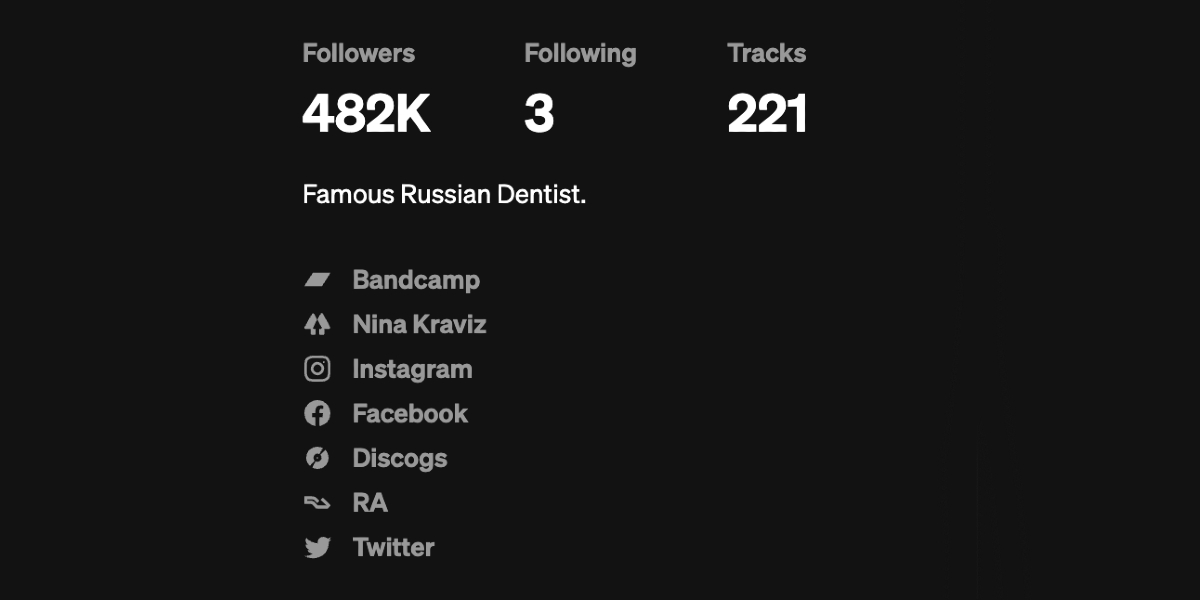
But the most important thing is that it explains, in a memorable way, what makes you different from other artists and worthy of the reader’s attention. In other words, what makes you special. (Another, rarer approach is to start with something cheeky and attention-grabbing. For instance: “Nina Kraviz is a famous Russian dentist.”)

From there, move on to the credentials. Tell us what parties you’ve played, what podcasts you’ve done, what records you’ve released on what labels, and so on. Focus on the examples that most clearly reflect your sound and level of stature so far—and feel free to round up slightly. If you play drum & bass, tell us the drum & bass parties you’ve played. If you’re a beginner DJ who’s scored a few decent-sized gigs over the years, prioritize the names of the biggest events you’ve played. If you’ve recorded mixes for any podcasts series, tell us what they are and link them. 

Finish with the actual biographical information—where you’re from, how long you’ve been playing, etc. If possible, try weaving this into the credentials section of the bio. But be wary of going back in time too early in the text. Some readers will tune out when they sense that what they’re reading is background info, even if it’s essential to include. If you feel like the life story is slowing the momentum of your DJ bio, kick it to the end and see how that works. 

Prepare three different sizes

In most cases, it’s a good idea to have three different versions of your bio: a full page, a blurb, and a micro-bio.

The full page—known in the PR world as a “one-sheet”—can live on a PDF that you send to whoever’s interested, and wherever it fits online. This will be a handy resource for someone who’s researching you and wants as much info as possible. 

In the blurb, you’ll trim all that info down into one bite-size chunk, probably one or two paragraphs long. This is handy because it can be used as-is in a greater range of contexts than the full-pager. For instance, if you’re playing a gig and the promoter is writing promotional text for the party with a few words on each artist, they can simply copy and paste your blurb, rather than cherry-picking details from your one-sheet. 

The micro-bio takes this idea a step further, distilling the whole thing into a single sentence that can fit into the “bio” sections of your social media accounts. You may want to tailor it specifically to each platform in one way or another, but it’s useful to have a closely considered base text to work from. 

In general, challenging as it is, it’s simply good practice to have such a clear idea of what you’re trying to say that you can say it in one sentence. By sweating this one sentence, you’ll end up with a useful and broadly applicable asset, while also gaining clarity on how the longer versions of your bio should read. (In most cases, the micro-bio will work, as-is or slightly tweaked, as the opening sentence of the other versions.)

How (and how not) to use AI

AI apps like ChatGPT can be helpful with this kind of task, especially if you’re not an experienced writer. That said, we’d advise against leaning on it too heavily. As time goes on, it becomes more and more of a faux pas to present as your own something that was written entirely by AI, or even sounds like it may have been. And, at the risk of sounding old-fashioned, you should want your bio, or anything that represents you as an artist, to be more real and unique than anything a large language model can dream up (at least with the tools we’ve got in 2026). 

One good way to use AI is to help you edit your bio into different lengths. Start with your full one-sheet. Drop it into ChatGPT and ask it to boil this down to one paragraph. Edit the result as needed. Once you arrive at a blurb you’re happy with, have ChatGPT boil that down to one sentence. Even if you don’t use any of what it spits out, this can be a helpful prompt for your own original versions of these texts, especially if you’re feeling stuck. 

Consider hiring a pro

If you have no writing experience beyond school and university work, you should closely consider hitting up someone who does. Writing professionally for an audience is its own kettle of fish, and even if you feel confident about your skills as a wordsmith, you shouldn’t expect to get it right if you haven’t done this kind of writing before. 

At the very least, find someone to edit or give feedback on your bio. Even among professional writers, the second set of eyes is essential. Nearly all professional writing you read has been edited or revised by someone other than the author. No matter how confident you feel about your own text, definitely run it by someone else before you make it public. 

If you have any friends who earn money doing any kind of writing—journalism, advertising copy, creative writing—they should be your first port of call. If there’s no one in your life who fits the bill, try contacting a music journalist. People who write for music magazines and websites are usually freelance, happy to get some extra work, and are experienced in artist bios specifically (it’s a common side gig for music critics). Spend some time reading online content. If you find someone who seems like a good fit—namely, you like their writing, and they write about the kind of music you play—find them on social media and slide into their DMs.  

Once you’ve got someone to write your bio, schedule a phone call to talk about what you want and don’t want, and hear their opinion on what they think the best approach would be for you personally. Be as specific as possible with regards to length, content, style and so on. Let the writer pitch a fee based on how much work they think will be involved, and negotiate if necessary. People charge anywhere from €100 to €1,000 for a DJ bio, based on the stature of the artist and the time and work that goes into the job. 

That said, (and while this suggestion inevitably carries the bias of coming from a freelance writer), even for a relatively quick bio of a lesser-known artist, €100 should be the absolute minimum you’d pay. When you put together the whole process, from the comms to the actual writing and the feedback process, you’re looking at a day’s work, minimum. Any figure under three digits will feel pretty light, and probably won’t inspire the writer to do their best work. (That said, if you send them a finished text and ask them for feedback or small edits, €50 might do it.)

Whatever you do, avoid clichés

Let’s circle back to that first point: think about your reader. A big part of your intended audience here is industry professionals, whether it’s club bookers, journalists, publicists or promoters. These are people whose work exposes them to a relentless parade of promotional text. The easiest way to lose their attention, or elicit a groan and an eye-roll, is with text they’ve seen nearly word-for-word countless times before—in other words, a cliché. 

The DJ bio, like any codified form of text, has its own set of clichés, each of which will make yours harder to take seriously. You can find out what they are first-hand by reading a bunch of other DJs bios (something you should do anyway for research). For a highlights reel of the classics—and a helpful parody of the nightmare DJ bio—we refer you to ethnomusicologist Luis Manuel Garcia’s 2010 article The DJ Anti-Profile: How Not To Write A DJ Bio, which, for better or worse, is still right on the money today (“DJ Glittersnizz has been rocking the decks since he was barely toilet-trained, when he rifled through his parents’ vast and eclectic record collection and started experimenting with the controls on their old walnut-veneered record player…”)

When in doubt, avoid saying anything that’s true of many or most DJs. Virtually any DJ worth knowing about “blurs the boundaries between genres,” “was interested in music from an early age,” “began playing local parties,” and so on. If it’s true for most DJs, it’s not interesting to hear that it’s true for you, too. In DJ bios, as in DJing, the best way to make an impression is to emphasize what makes you different from everyone else.

Three examples of effective DJ bios

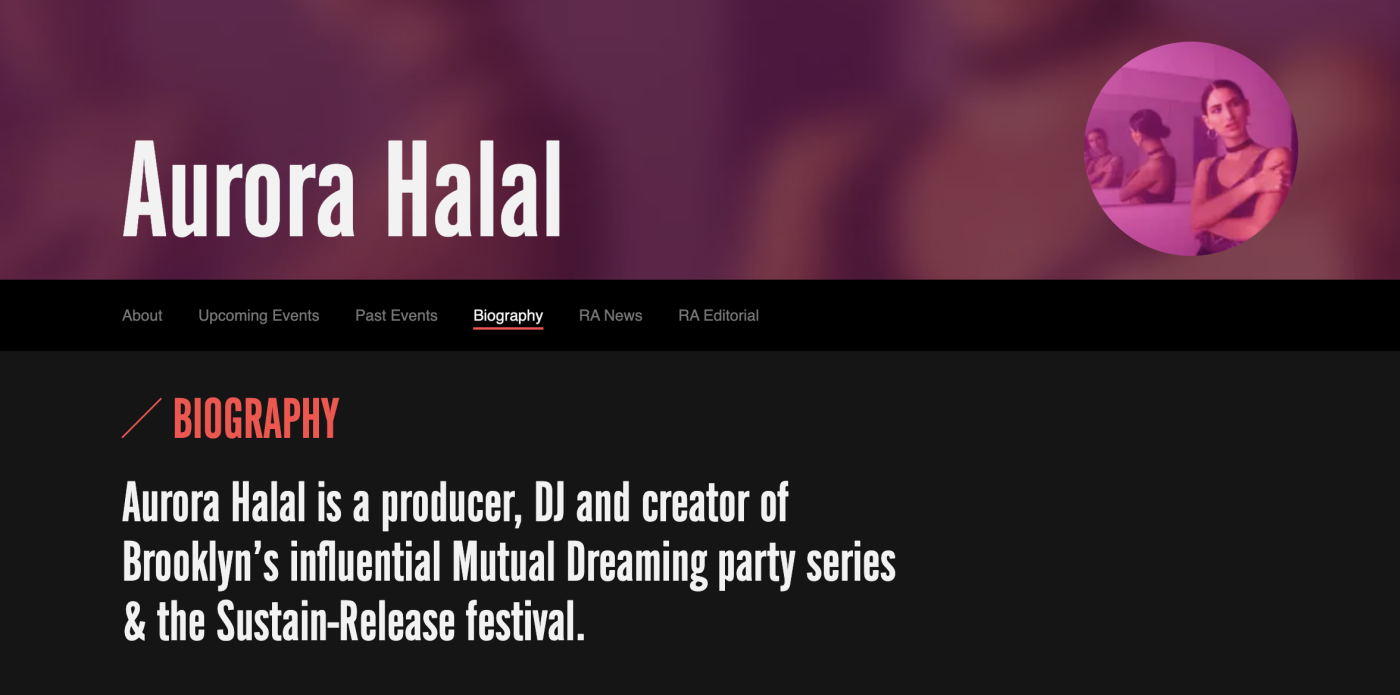
Aurora Halal

This is a good example of a straight-forward, well-rounded, medium-length bio. We get evocative descriptions of the artist’s signature sound, but move through them pretty quickly. The biographical section is propped up by a list of achievements presented humbly (“she’s known for creating space for the underground to thrive through Sustain-Release, the upstate festival she founded 10 years ago, and her influential party series Mutual Dreaming”). In just a few sentences, we get the impression that Halal is not only a compelling artist in her own right but a pillar of New York City’s DIY club community—a strong ethos that goes well beyond what she plays in her DJ sets.  

Nina Kraviz

Exhibit A of a punchy, effective micro-bio. Naturally a special case in the sense that the reader will already know a lot about the subject so a lot of the heavy lifting is already done. But the cheeky opening and closing lines make the whole thing funny and memorable, and bring a human element to Kraviz that even her fans wouldn’t already know. 

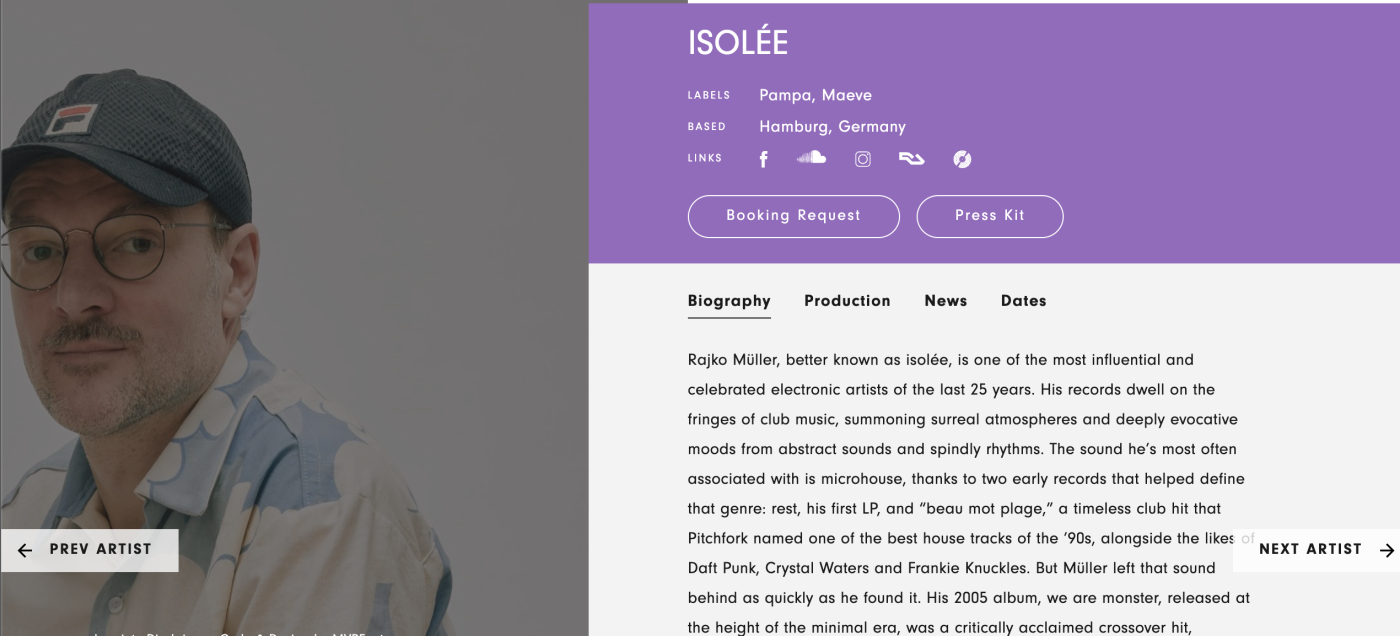
Isolée

Full disclosure, this one was written by your author. This is an example of how a bio can reset the narrative on an artist who’s been around for a while, in this case setting the stage for the reemergence of the microhouse producer Isolée ahead of what was essentially a comeback album. The main goal is to make it clear that this guy is an influential and accomplished artist who very much deserves your attention, even if you’re too young to remember his first golden era, which, 20 years on, may be the case with many of the industry folk who end up reading this bio.
Text: Will Lynch