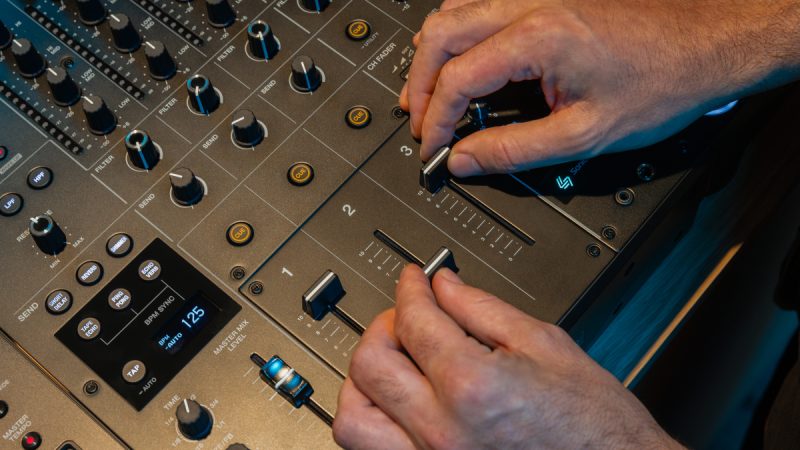
Let’s explore another example that involves using DJ tools. Decks 1 and 2 are your standard full-track mixing channels. They represent the workflow that you’re already familiar with, so no change there.
Then we add deck 3, which will be used exclusively for percussion and drum loops. These could include everything from simple open hi-hat patterns to complex hand-drum performances.
Deck 4 will be for acapellas, or vocals without any instrumental accompaniment, and sound FX. (For reference, both acapellas and percussion loops are widely stocked in DJ download stores.)
Even with this relatively simple application of multi-deck mixing, your creative options have just increased exponentially. Consider how different your sets would sound if you played with different rhythmic accents through percussion loops, while you could grab the crowd’s attention by judiciously dropping vocals they know.
These additions mean that you have more fine-grained methods for responding to a room. A two-deck DJ can address a sagging dance floor by changing tracks or by using FX; their multi-deck counterparts have a broader and more nuanced range of tools at their disposal. It might be, for example, that a hi-hat loop is all that’s needed in any given moment. Or that the tease of a lively vocal is the energy injection that’s needed.
And to flip this example on its head, rather than extra ways to problem solve, multi-deck mixing offers more ways to express yourself.
We’d generally recommend taking a simplified approach, along the lines we’ve outlined here, when you’re starting out with multi-deck mixing. Confusion and creative overwhelm are your main obstacles at the beginning (and are probably the reasons that people don’t get started with the technique to begin with).
Simplifying things even further, it could be that a third deck is used for tracks that you’re planning to play at some point and want ready to go. In this example, you may never have three tracks playing simultaneously. But the way you think about sequencing music has changed.
Or tweaking the approach a bit, you could use rekordbox to pre-program loops you like in your tracks and have fun punching in these loops from the third deck when you feel the time is right.
You can see now why multi-deck mixing is such a creatively exciting but potentially confusing area. It’s possible that no two DJs have the exact same workflow. As we’ll cover again in later sections, there is a vast scale of multi-deck mixing with totally pre-planned and controlled at one end, and pure improvisation at the other end.