From EFX to RMX, we explore the evolution of our DJ effectors

Since 1998, DJs looking to add a unique flavour to their sets have turned to the EFX and RMX units. We asked our product planners for the inside story.

Listen to this article, written by Bridge editor Ryan Keeling

Since the release of the first CDJ back in 1994, one of our guiding principles has been to give DJs tools to express themselves in ways that go beyond simply playing tracks. Although there was very little call for it at the time, our first club mixer, the DJM-500, arrived in 1995 loaded with six different FXs. “An idea popped into our mind that by adding effects, DJs would be able to entertain the audience even more,” remembered Kou Atsumi, who led product planning for the DJM-500. 

Back then, the classic setup of two turntables and a mixer was more than enough for most DJs. But like the early adopters of CDs for DJing, there were some DJs who could sense the possibilities of the emerging digital tools. “The FX [on the DJM-500] were very important because it then created an additional level, an additional layer to my performances,” said Roger Sanchez back in 2014. 

“The DJM-500 was well received, but some DJs felt that the small, segmented controls didn’t quite match their performance style,” said Atsumi. “They wanted something more expressive and hands-on. That led us to the idea that creating a standalone effects unit could be the solution…”

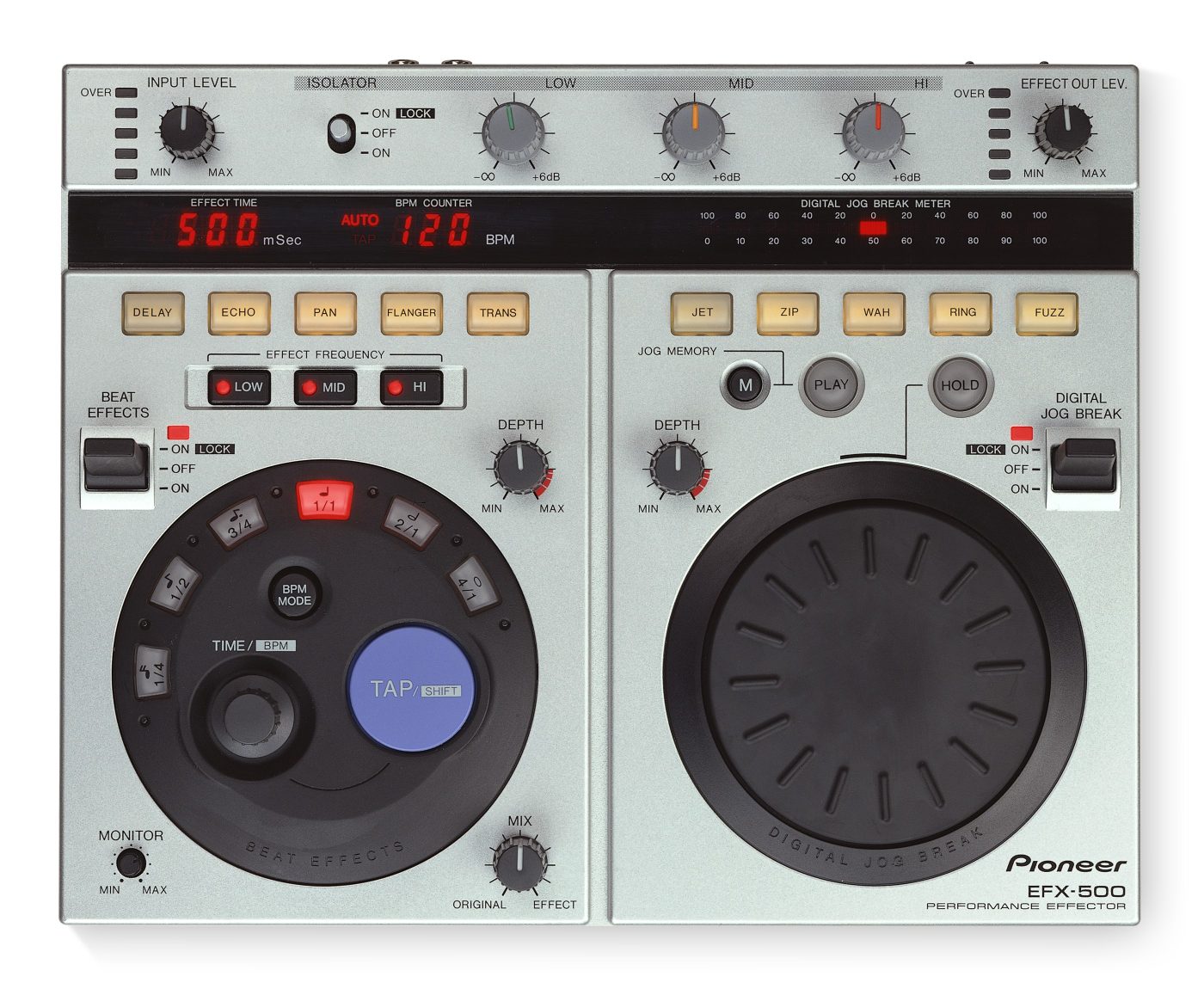
EFX-500 (1998 – 2010): The experiment   

For some older DJs, just the sight of the EFX-500 can evoke nostalgia. Its design brings to mind some of the earliest Pioneer DJ products—the CDJ-100-S, the DJM-300 mixer, the CDJ-500-S—which could all be found in many homes and DJ booths in the late ‘90s and early 2000s. 

Using the unit in 2026, it’s immediately obvious that retro looks come with retro sound. Thanks to its 8-bit output, the FX on the EFX-500 have a crunchy quality that show the unit’s age. Still, it’s worth remembering that at the time it would have been a game-changing tool for many DJs. Until the mid-to-late ‘90s, there were very few mixers on the market with FX, and some DJs were resorting to using guitar pedals.  

“On the left, you have Beat FX; on the right, Digital Jog Break,” said Atsumi. “Both areas were designed to really bring performance to life. Our goal was to create a piece of gear that could deliver the kind of bold, dynamic expression that only digital technology makes possible. 

“We decided to put Beat FX front and center with this product, hoping it would spark broader interest in our ecosystem, including CDJs and DJMs. And in practice, we had even some vinyl DJs using the EFX-500.

“The rise of Beat FX was closely tied to the popularity of DJs playing four-on-the-floor music with a strong, clearly defined sense of rhythm. Roger Sanchez was hugely influential at the time, and we already had a relationship going back to the DJM era. His style helped shape the idea of building performances around FX.”

“When I first started DJing, it was all about the seamless flow of music and taking people on a journey,” remembered James Zabiela. “And the great thing about the Pioneer equipment, especially with the EFX stuff, is it enables you to be a performer as well.”

“When we handed him a demo unit, he treated it almost like a living creature, delivering an incredibly striking performance. For him, the EFX became the perfect tool to DJ in a truly expressive, dynamic way.

“In Japan, DJ Krush also showed interest. At the time, he wasn’t someone who typically used our products, but he was intrigued enough to take it with him on tour. He represents a more experimental, deeply turntable-focused approach to DJing, and this was a clear example of the product resonating with that kind of artist. Ken Ishii and Takkyu Ishino were also interested—both are techno DJs known for driving energy on the dancefloor—showing that the EFX appealed strongly to DJs focused on building momentum and intensity.” 

The EFX-500 also marked the beginning of our limited-edition runs of products. 200 “snow white” versions of the EFX-500 were released back in 2000, which was followed up by a more widely available red edition in 2006. There is also a blue EFX-500—although apparently James Zabiela has the only unit that was ever made.  

“With a first-of-its-kind product, there is always a sense of uncertainty—it may or may not succeed,” said Atsumi. “While CDJs and DJMs are essential tools for DJ performance, an effector is not strictly required to play music. Launching the EFX series was also a statement from the company: that we wanted to release equipment designed to further support and expand DJ performance beyond the essentials.

“Including CDJs, it generally takes time for any piece of equipment to become a true standard. With effectors in particular, the challenge was to make DJs who felt that ‘players and mixers are enough’ think ‘this makes things more interesting.’”

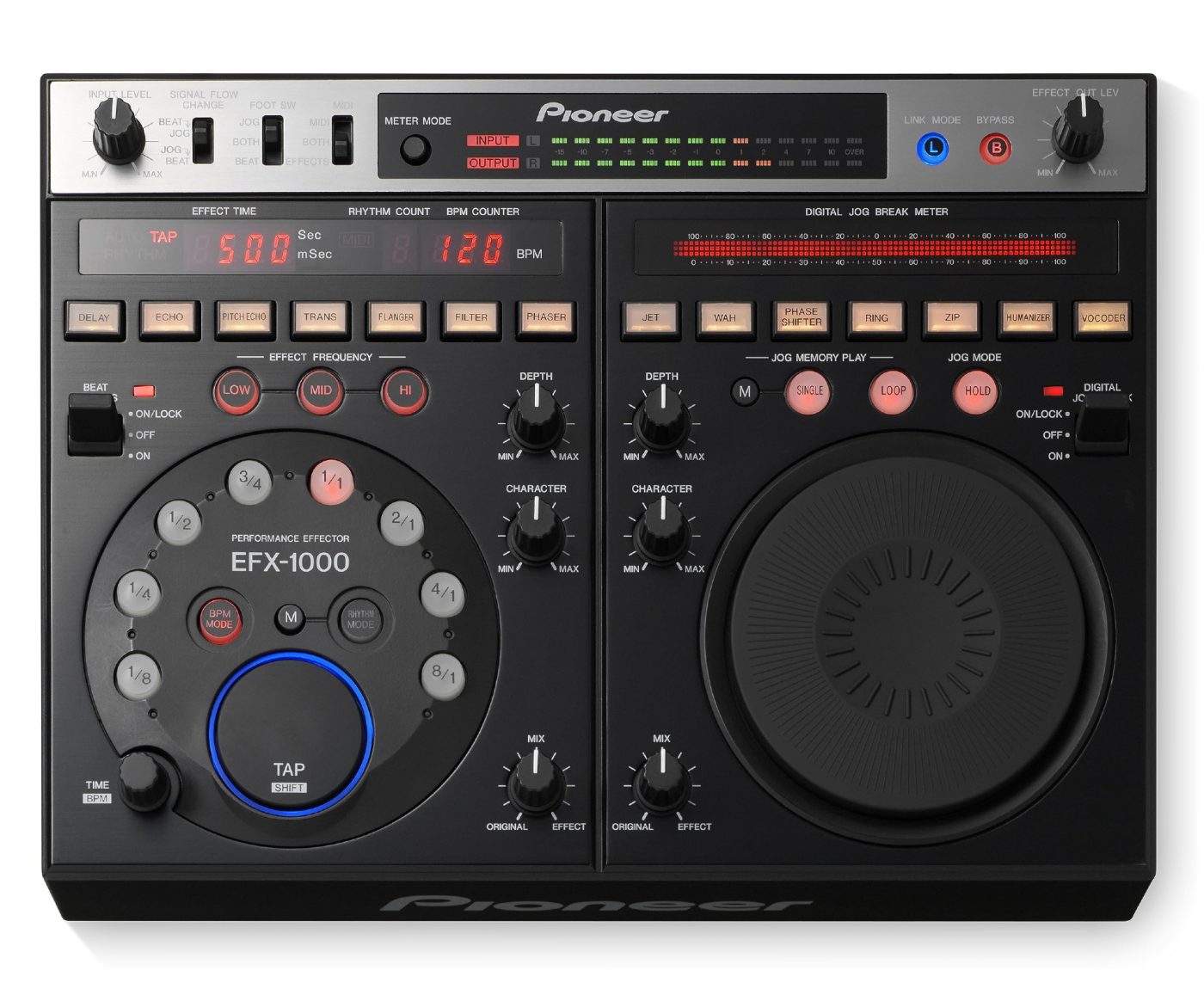
EFX-1000 (2005 – 2012): More and better

Seven years after it launched, the EFX line got its first major update: the EFX-1000. The EFX-500 proved to be relatively successful, gaining solid traction with DJs within a few club music scenes. But there was a sticking point: its sound quality.

“The EFX-500 did not always receive strong feedback in that respect, so enhancing audio quality became a priority,” said Atsumi. “We also expanded the variety of effects available. The fundamental design approach remained the same as the EFX-500, but the EFX-1000 was conceived as an upper-tier model.” 

The new unit jumped up to a 24-bit / 96 kHz output and came loaded with seven BPM-synced FX (delay, echo etc) and seven Jog FX (phaser, flanger etc), which were controlled by turning the Jog wheel. 

“By increasing the number of parameters, users were able to create newer and more diverse sounds,” said Atsumi. “In addition to the Depth parameter, we introduced a new concept called Character, allowing for more detailed tonal shaping.

“We also upgraded the Jog Break section. Previously, effect-blending control was limited mainly to Beat Effects, but with the EFX-1000 users were able to adjust how effects were mixed within Jog Break as well.

“When we shared prototypes of both the EFX-500 and EFX-1000 with DJs who participated in our testing and feedback process, the response was very encouraging. Seeing them used in real performance contexts validated our hypotheses—both regarding the enjoyment of Beat FX and the creative potential of effects that are not locked to the beat. That feedback gave us confidence in the direction we were taking.

“Overall, the response was positive. The EFX-1000 spread particularly among DJs in specific genres and among those who were actively seeking new sounds and performance possibilities.

Our broader ambition was for it to become a standard piece of equipment—on the same level as players and mixers. While it did not ultimately reach that level of standardization, we believe that this goal was later realized with the RMX-1000.”

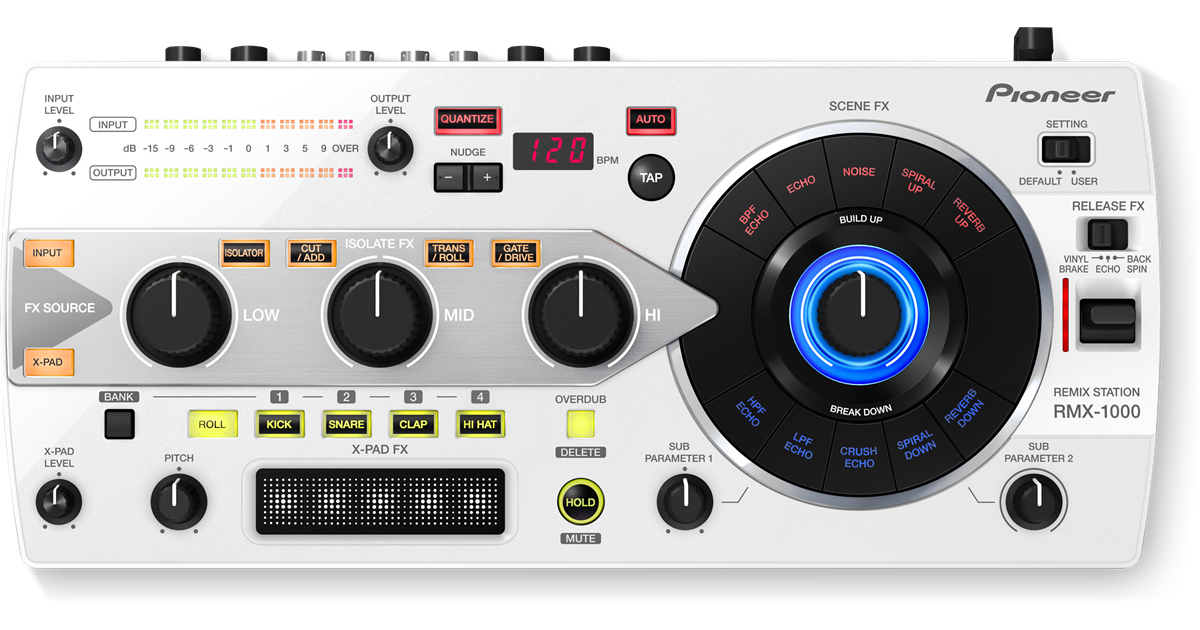
RMX-1000 (2012 – 2025): The age of the remix

There are a handful of products that could make a strong case for appearing in an all-time Pioneer DJ / AlphaTheta setup. As our longest-running product ever, the RMX-1000 is definitely among them. Although it was conceived at a time that predated even the rise of EDM, the RMX-1000 was only eventually retired last year, such was its enduring appeal. 

“Trance and electro house were still dominant at the time,” said Nao Takagi, a product planner on the RMX-1000, reflecting on the RMX’s development around 2009. “And while there were hints of what EDM would become, the big-room sound as we know it today hadn’t fully taken shape. Tracks tended to have longer developments, with extended build-ups and drops.

“If you look at someone like Armin van Buuren around 2009, you might feel today that the transitions are quite long. But at the time, we were closely watching how DJs built energy over those extended moments and how audiences responded. That led to a clear intention: to add even more energy to those climactic sections.

“That’s why we didn’t want RMX-1000 to be just an FX unit. We felt a sampler was also necessary.”

On the EFX units, parameters like Depth were clearly exposed, allowing DJs to adjust effects in a logical, precise way. The RMX, on the other hand, was designed around emotion and intuition. “It’s less about logically shaping parameters and more about answering a simple question: ‘Do you want to build the energy here, or not?’

“We designed it so that simply turning the knob from left to right would naturally create a build-up. The RMX was all about making that excitement happen effortlessly.” 

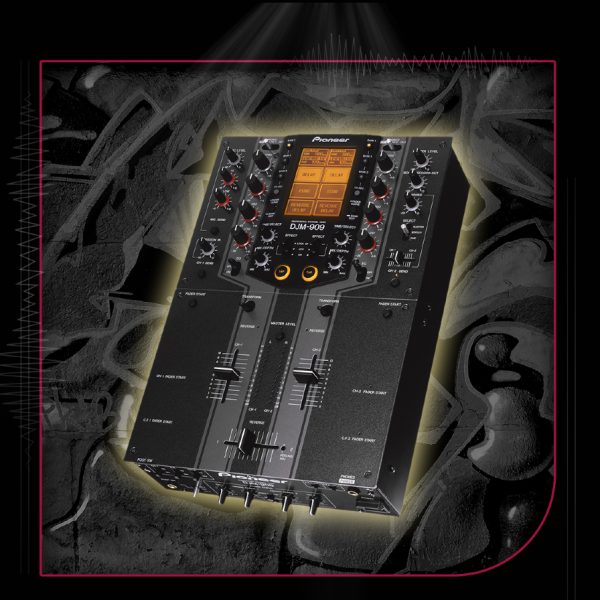
Although it’s not a widely known mixer these days, the DJM-2000, which featured a prominent touchscreen FX section in its centre, was a key starting point for the RMX-1000.   

“At one point, it was suggested: ‘Why don’t we turn just the effects section in the middle of the DJM-2000 into a standalone product?’” said Shogo Suzuki, one of the RMX-1000’s product planners. “At the time, manipulating sound with effects was becoming increasingly popular. But if we simply extracted that center section as-is, it would have ended up as another EFX. So we went back to the drawing board and rethought the concept entirely.”

“DJs like Armin van Buuren and Carl Cox could specify the DJM-2000 on their technical riders, but many others couldn’t,” said Takagi. “The RMX began as a project aimed at those DJs—people who needed a powerful tool they could bring with them.

“Portability was a key consideration, which is why the unit was designed to be compact. We also deliberately changed the product name from EFX to RMX. The intention wasn’t just to ‘add effects’—it was about remixing tracks live. That idea is exactly what RMX stands for.”

“There was also an idea to pack in as many different effects as possible, but we ultimately decided against that,” said Suzuki. “Rather than creating an overwhelmingly powerful effects unit, we chose to focus on a more fundamental question: what do DJs actually want to do when they use effects?

“The answer we arrived at was simple: wouldn’t it be amazing if DJs could improvise with track structures in real time and control the energy of the floor more freely? Creating breaks that weren’t originally there, or adding fills to push a moment further. That kind of freedom became the core concept.

“Our team at the time had many active DJs. We believed that DJing wasn’t just about the inherent power of the track itself, but about the feeling you get when you actively shape the music, almost as if you’ve suddenly become a genius, controlling the entire space. We wanted more people to experience that sense of freely commanding the energy of the floor, and we set out to build a piece of gear that could make that possible.” 

However, this emphasis on controlling and building sound did introduce a big challenge. As Takagi pointed out, it’s easy to apply effects, but it’s surprisingly difficult to end them cleanly. “That challenge led directly to the creation of Release FX,” he said. “Even after layering multiple effects, DJs needed a way to return to the original sound instantly, with a single action. That was absolutely essential.”

There was also an unexpected but important piece of feedback the team received from a DJ: “You wouldn’t be able to use this in a club when you’re drunk.”

“That feedback was decisive,” said Suzuki. “From that point on, our goal became clear—we wanted RMX to be usable even in that state.” 

Suzuki talked about the flexibility of the unit, especially through the use of the sub parameter controls. “Those sub-parameters change their labels depending on the selected effect, and preferences really vary from DJ to DJ, so we designed it to be highly customizable. When I saw James Zabiela switching those parameters and effectively playing the unit like an instrument, I remember thinking both ‘that’s a really interesting way to use it’ and being genuinely surprised.” 

But in some DJ circles, the RMX-1000 became almost infamous for one feature in particular: its snare roll. “Looking at how people actually used the unit, I think a lot of DJs gravitated toward snare rolls,” said Takagi. “That made sense, because we were really asking a simple question: if someone wants to build excitement, what kind of sampler or effects unit would truly help them do that?

“At the same time, looking back, I think we may have been a little too influenced by the flashy trance scene of that era. The RMX-1000 sound became very recognizable—almost too recognizable—and over time, it risked becoming a sound people grew tired of.

“With the new RMX-IGNITE we took a different approach. We wanted to strip away that ‘obvious’ character and create an effects unit that DJs could use for a long time, without it feeling dated.” 
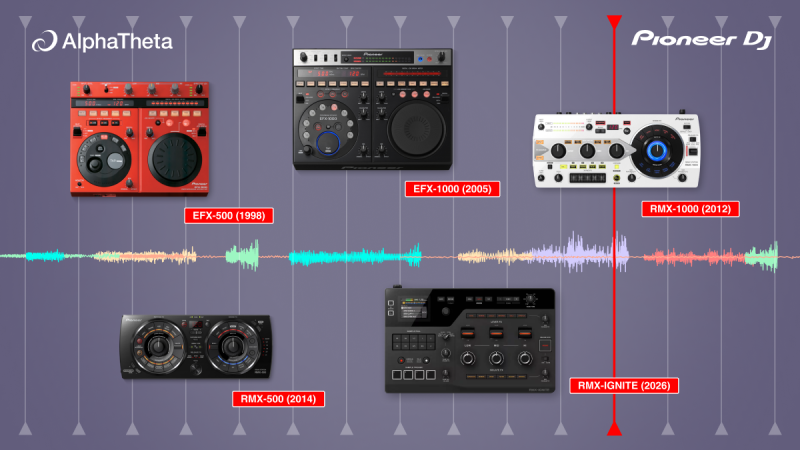
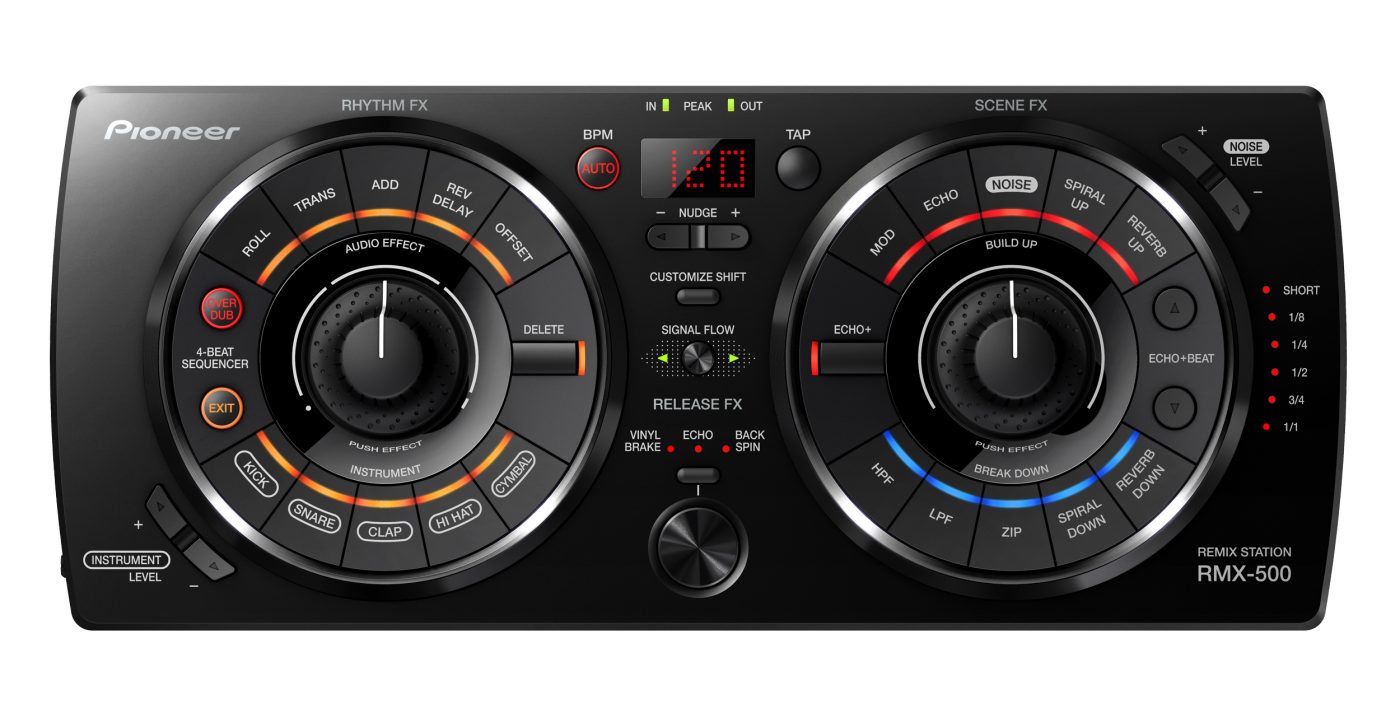
RMX-500 (2014 – 2020): Energy and emotion

The RMX-1000 was designed to immediately create energy and emotion on the dance floor. The RMX-500 took this approach even further.

“While RMX-1000 still involved parameter settings, RMX-500 aimed for something even more immediate—an instrument that could be used emotionally and instinctively, without the risk of failure,” said Takagi. 

This slimmed-down version of the RMX-1000 featured two circular sections of controls: Scene FX on the right, which were carried over from the RMX-1000, and Rhythm FX on the left, which housed audio FX and a drum machine.   

“By the time the RMX-1000 was released, EDM had already reached a point where track structures became much quicker,” remembered Takagi. “Slowly and gradually building energy no longer matched the pace of the scene.

“The RMX-500 was our answer to that shift. It was designed to create excitement more quickly, without hesitation.” 

Like with the RMX-1000, the RMX-500 was replicated as a VST plug-in for use in music production. “At the time, the iPad had just been released and was generating a lot of buzz,” said Suzuki. “During field tests, we asked professional DJs who also produced music to review the RMX-1000. Many of them said, ‘We want this as a plug-in, we’d use it in production as well.’

“This was also the first time we created effects plug-ins aimed at music production, and honestly, it was a very improvisational and almost acrobatic project.” 

The next RMX product would be developed along a very different timeframe…

RMX-IGNITE (2026): The modern DJ tool  

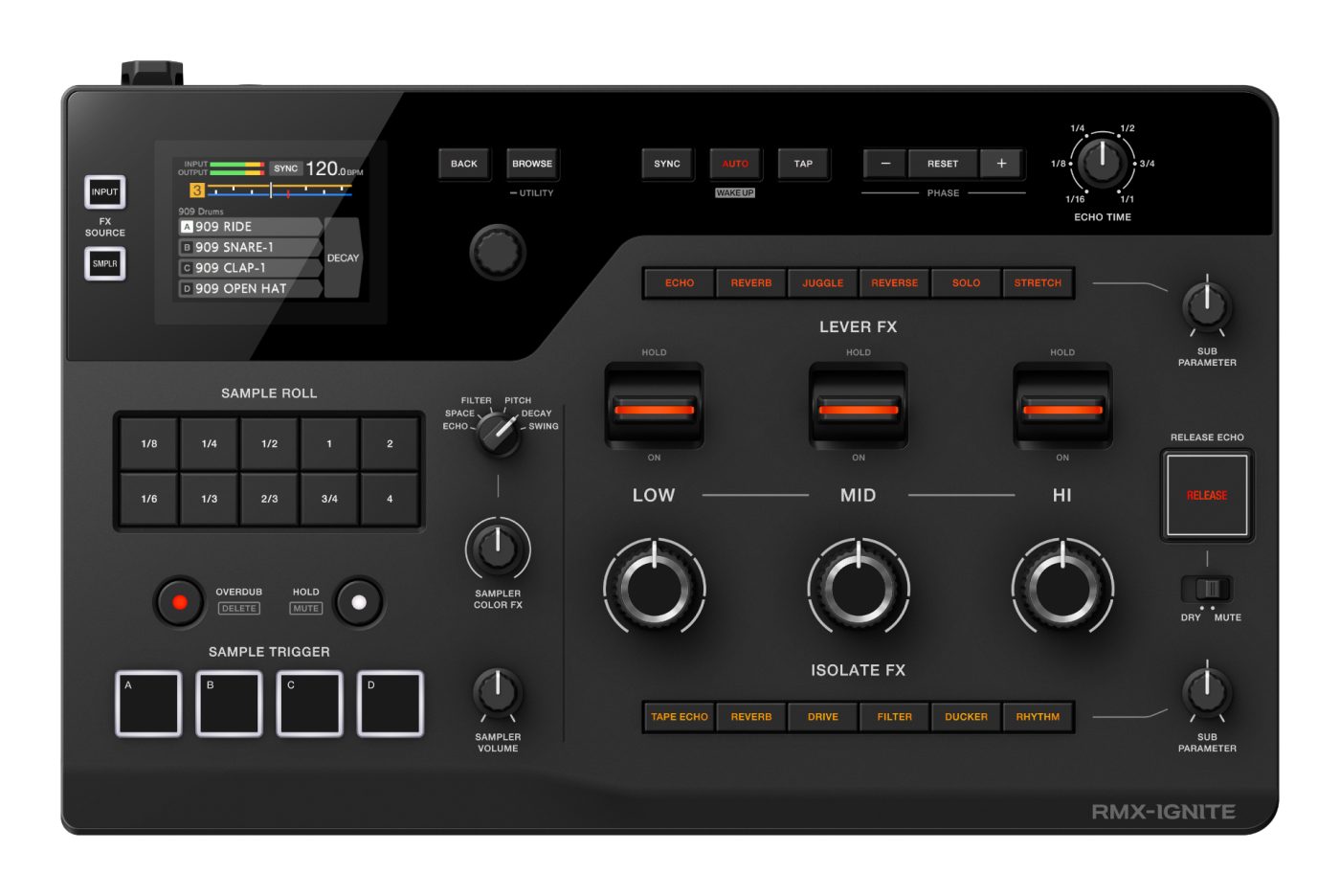
Fast-forward to 2026 and the recent arrival of the RMX-IGNITE. With so much time passed since the RMX-1000, it was natural that this new unit would respond to the needs of modern DJs. 

“Up until around 2012, DJ individuality was primarily expressed through track selection, beatmatching, and mixing technique,” said Tamon Hatanaka, the product planner for the RMX-IGNITE. “While these remain core DJ skills, the rise of festival culture and social media has made real-time self-expression during performances increasingly important. Audiences now expect to see DJs actively shaping sound in the moment, not simply playing tracks.

“Technological expectations have also evolved significantly. Higher sound quality, faster setup, and the ability to perform hybrid sets across genres are now standard requirements. As dance music has moved onto larger festival stages, DJs are increasingly expected to create their own sense of development even within minimal track structures.”  

With the features of the RMX-1000 being relied upon by DJs across so many years, it was always likely to be a case of evolution rather than revolution with the RMX-IGNITE. 

“We wanted to preserve the core concept of RMX-1000 as more than just an effector—as a live remixing tool—and to retain the essential elements that DJs valued most,” explained Hatanaka. “These included the X-PAD, which allowed DJs to emphasize build-ups by adding rhythmic rolls, and the strong presence of the unit as a dedicated ‘performance surface’ placed separately from the mixer. 

At the same time, the RMX-1000 made certain limitations clear. Many of its FX were overly aggressive, and the X-PAD rolls could feel repetitive, resulting in performances that sounded similar regardless of who was using the unit. This made it difficult for DJs to express individuality. 

“In addition, its sound quality did not meet the 96kHz/32-bit standards now expected in professional environments, and the four-cable send/return connection led to setup complexity and on-site errors. RMX-IGNITE addresses these issues by offering more musical and flexible FX, a more intuitive and distinctive sampler section, and a highly reliable, high-quality USB single-cable connection. 

“The vision behind RMX-IGNITE was to redefine the role of DJ effectors in the booth to suit the next generation of performance. Over the past decade, DJ culture has evolved beyond simple beatmatching and smooth mixing, increasingly incorporating elements of live performance—such as instrumental and orchestral expression—to create a stronger sense of musicality and presence. RMX-IGNITE was designed not as a tool to simply decorate tracks with effects, but as a performance instrument that allows DJs to reconstruct sound in real time and fully express their individuality.”

This idea of individuality came through in some of the pre-release demonstrations we gave DJs in the UK. The RMX-IGNITE can be loaded with your own samples, and while drums might seem like an obvious choice, some DJs saw the potential in loading in their own idents, musical parts, and sound FX. 

“Modern tracks are often highly polished, and many DJs want to layer an additional level of personal expression on top,” said Hatanaka. “With the Sample Trigger pads, DJs can add hi-hats or claps to the playing track, creating tension and anticipation during build-ups.

“The Groove Roll function goes further by enabling not only simple rolls, but also more distinctive rolls and polyrhythmic patterns through multi-button operation. This can dramatically change the texture and energy of the dance floor. In addition, the Sampler Color FX allows DJs to add spatial and tonal character to sample sounds without disrupting the original track, making the sampler a natural extension of live performance.”

On first glance, the RMX-IGNITE seems like quite a departure from the RMX-1000, the compact design of the latter being replaced by a larger unit in a more sleek black-and-grey finish. But the basic logic behind the way sound is processed has remained. 

“The layout of RMX-IGNITE builds on the left-to-right horizontal ‘flow of sound’ established by the RMX-1000, while being refined to emphasize playability and performance,” Hatanaka said. “The section most frequently used on the RMX-1000—the X-PAD (sampler)—is positioned on the left, while the 3-BAND FX section, which can process both the input audio and sampler sounds, is placed on the right. This creates a layout that is visually easy to understand and operationally intuitive.

“Within the 3-BAND FX section, the ISOLATE FX and LEVER FX are arranged vertically in two clear stages. This design highlights both their role as performance controls and the creative freedom that comes from combining multiple FX to shape sound and musical development. The sampler pads use a high-contrast monochrome design to support precise timing, while subtle tilting, sculpted rear panels, and diagonal accents enhance the visual impression of physical interaction with sound. From the moment it is placed in the DJ booth, the design clearly communicates that RMX-IGNITE is not just an accessory, but a performance instrument.”

Atsumi, who’s been with the company since the early ‘90s, reflected on the unique position that FX and sampler units have come to hold in the DJ market. “Some DJs are conservative by nature, precisely because they have a clearly defined personal style,” he said. “Still, we hope that RMX-IGNITE will successfully communicate its value to users and become a more standard, everyday piece of equipment.”

Text: Ryan Keeling