An inside look at our all-in-one DJ systems

The people behind our XDJ range reveal the major decisions, design choices, and technical challenges that have shaped the series.

One of the big challenges for the people who design DJ gear is trying to predict what comes next. The market is continually reshaped by the evolving ways that DJs play—from vinyl and CDs, to the current wave of cloud DJing—and nailing the timing of the next step is tricky.

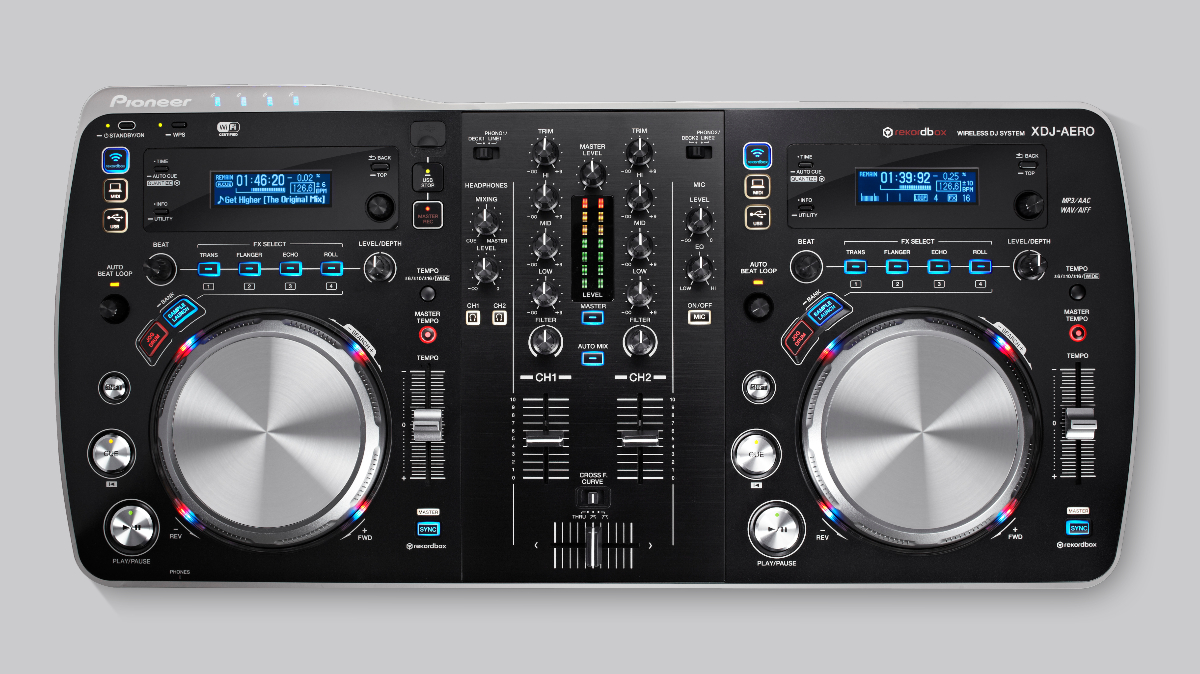
“The biggest question was whether we should include CD playback, or whether we should create a new kind of all-in-one unit without CD,” says Atsushi Watanabe, product planner for the XDJ-AERO, our first-ever all-in-one unit, released in 2012.

“At the time, CDs were still the main media format. Eventually decided to take the plunge and remove CD playback. The thinking was that media would move toward file music in the future, and that was something we wanted to try as a company.”

Watanabe and the team were, of course, correct that music files would become the dominant format. But it didn’t quite happen in the way they pictured with the AERO. The unit’s proposal was that DJs would connect to the unit over Wi-Fi and play back music (via the earliest version of the rekordbox app) from their iPhone.

This mode of DJing didn’t catch on at the time, but in trying to anticipate what came next the team had the beginnings of a product line that’s now central to the AlphaTheta / Pioneer DJ story. (Funnily enough, the most technologically advanced way to play these days is to load up your cloud music collection via your smartphone and the rekordbox app.) It wasn’t clear in 2012 what the range would become, but these days XDJ is shorthand for “all-in-one” DJ systems, which essentially feature a DJM mixer and either two or four CDJs in a single unit.

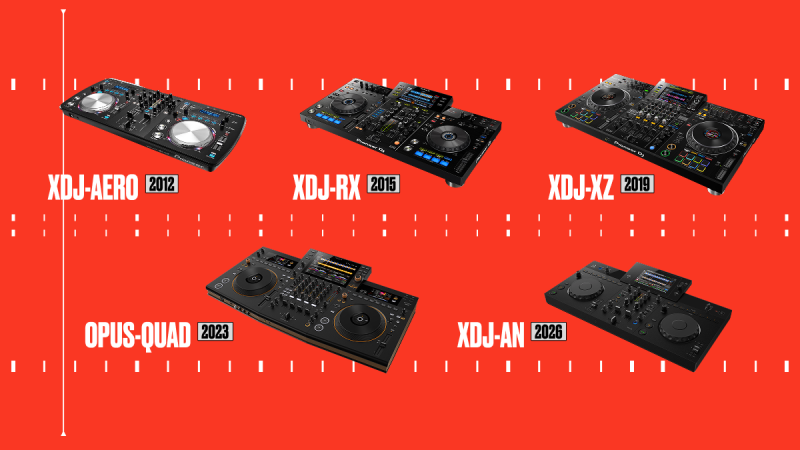
Beginning with the XDJ-AERO and finishing with our latest model, the XDJ-AN, we’re going to look back at the history of our XDJ range through the eyes of the people who shaped it. They reveal the major decisions, design choices, and technical challenges that have gone into creating the XDJ series, which has helped to welcome more people than ever into the world of DJing.

XDJ-AERO (2012) – A different way to DJ

XDJ-AERO

“We had not released an all-in-one unit yet, and we had only just released controllers,” says Atsushi Watanabe. “At the time, our controllers were not yet selling particularly well. Other companies had also released controllers and they were selling well, so the thinking was that we should expand beyond the single-player and single-mixer setup. That was the flow that led us to start developing both all-in-one units and controllers.

“When we thought about file music, the devices ordinary people used to listen to music at the time were shifting toward iPod and iPhone. File music was moving away from being something you cut out onto a USB drive, and more toward directly using an iPhone.

“Rather than making an iPhone controller, the idea was to allow people to use the tracks on their iPhone directly on actual hardware. That was the concept: a new kind of all-in-one unit dedicated to file music.

“In terms of newness, Wi-Fi was a major element. The iPhone was something people kept in their pocket, so instead of taking it out and connecting it with a cable, we considered whether the all-in-one unit could read and play the music over Wi-Fi. We discussed it with the technical team, and they said there was potential, so we positioned it as a product that let you DJ with an iPhone.

“The main difficulty in planning and development was whether to include CD or remove it.

“For me personally, the first thought was that I wanted to do something new. I wanted to present something that felt more advanced than previous DJ equipment.

“There was another point as well. rekordbox mobile exists now, but we created it for the first time around this period. The idea was that with rekordbox mobile, you could prepare tracks anytime and anywhere, such as on the train or outside, then connect that to AERO and perform on the actual hardware.

“Rather than preparing at home, exporting to USB, and then using that USB, the idea was that you could prepare anywhere and then connect directly to the hardware. You could connect wirelessly. That convenience was something we were thinking about at the same time.


“The phrase ‘anytime, anywhere’ came up among the planning members even back then. We made this model thinking that it could make that kind of thing possible, at least to some extent.

“We were also conscious of making the unit thin, like an iPhone. It had a playback engine inside, but we wanted it to be thin like a controller, or rather to give it an atmosphere similar to an iPhone.”

“With AERO, the idea was not simply that two players and one mixer had been combined into one unit,” says Yuji Murai, an executive manager in our product planning team. “It was more that DJing could be completed with this one device.

“I remember that the design concept intentionally avoided making it look like one thing had been attached to another. The UI layout was designed so that users would not get lost, while preserving the basic mannerisms of DJing.

“As the model name AERO suggests, we were conscious of air, of wireless rather than wired connection, of convenience, smartness and being cordless. We wanted to show that the media used by DJs was changing. Rather than following professional equipment, the manufacturing concept was that this was a completely new product format. That was reflected in the design and also in the model name.

“The target customers were not necessarily people aiming to become top club DJs. They were people who wanted to try DJing using the devices they already had in their hands. I think the target was a new kind of DJ experience for people who valued being able to use what they already had.”
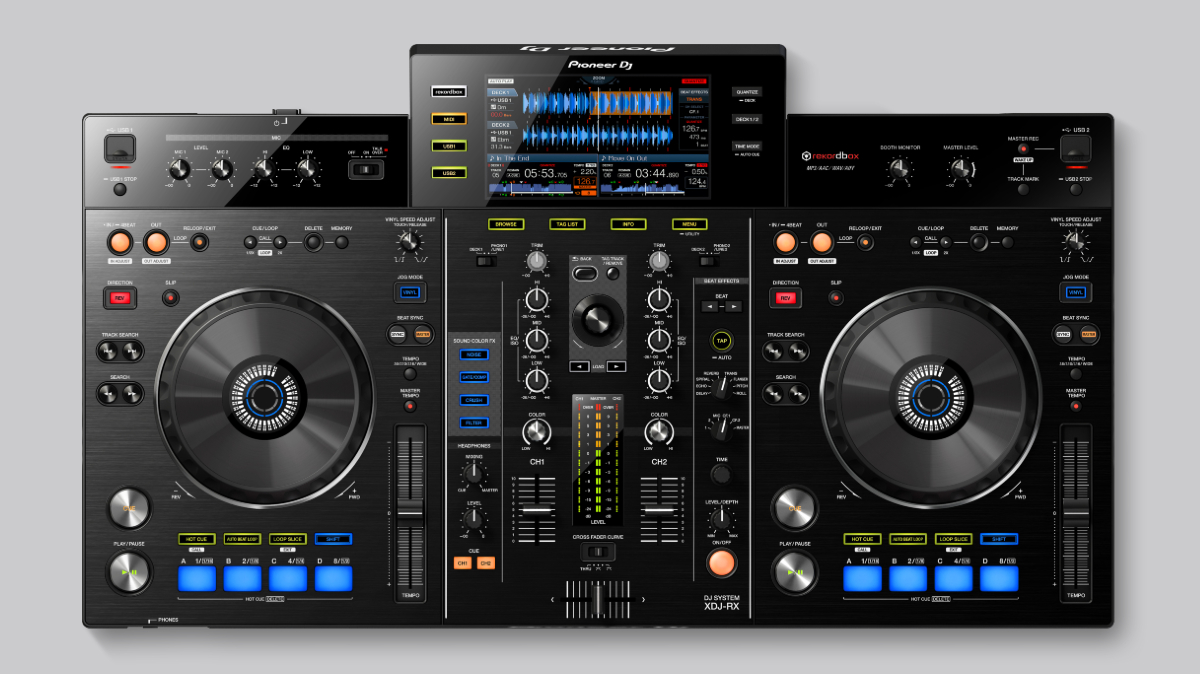
XDJ-RX (2015) – A new design standard 

XDJ-RX

“The XDJ-R1 was developed as a sibling model to AERO because there were also voices saying they still wanted to use CDs,” remembers Yuji Murai. “In emerging markets such as the BRICs, CD as a medium was still widespread, so it was also aimed at those regions.

“Then the XDJ-RX appeared. That was the point where a new concept emerged in our approach to making XDJ products.

“When controller users moved to the CDJ product format, there was a gap. Each controller model had its own individuality designed to make the most of the laptop, so it was different from the standard equipment installed in venues. People who started DJing on controllers and then went to play on CDJs at venues struggled with that difference. The gap had grown.

“So the XDJ-RX was positioned between controllers and separate products. It was a product that connected the home and the venue, providing an environment where users could play at home with a feeling close to the venue.

“The design, operation, and screen were all made with the emphasis that users could select tracks in the same way as with the CDJ-2000 series, and mix in the same way as the DJM-900 series.

“The background to this shift was that when using CDs, each player needed one disc. But when using USB memory or files on a computer, separate products require a system such as Pro DJ Link to share a single media source across multiple players.

“In that situation, there are ways in which an all-in-one unit makes more sense than separate components. If you are using USB memory, an all-in-one unit is rational.

“The market for lower-priced separate CDJs was also shrinking. More people were starting DJing on controllers, and users were polarizing between those using high-end separate CDJs and those using controllers.

“High-end products still need to be separate, but for more affordable home-use products, the all-in-one format became a more rational product form for customers. I think the market changed in that way.

“At first, we started from the idea that we would not make an all-in-one that looked like a CDJ and DJM combined. But eventually, that was exactly what the market came to demand.

“The market changed, and our perspective changed as well. Also, if the equipment had only played CDs, we might not have taken that route. But the media format changed to something like a USB memory stick, where all tracks are gathered in one container, and that increased the role and demand for XDJ all-in-ones: products where the CDJ and DJM are integrated into one.”

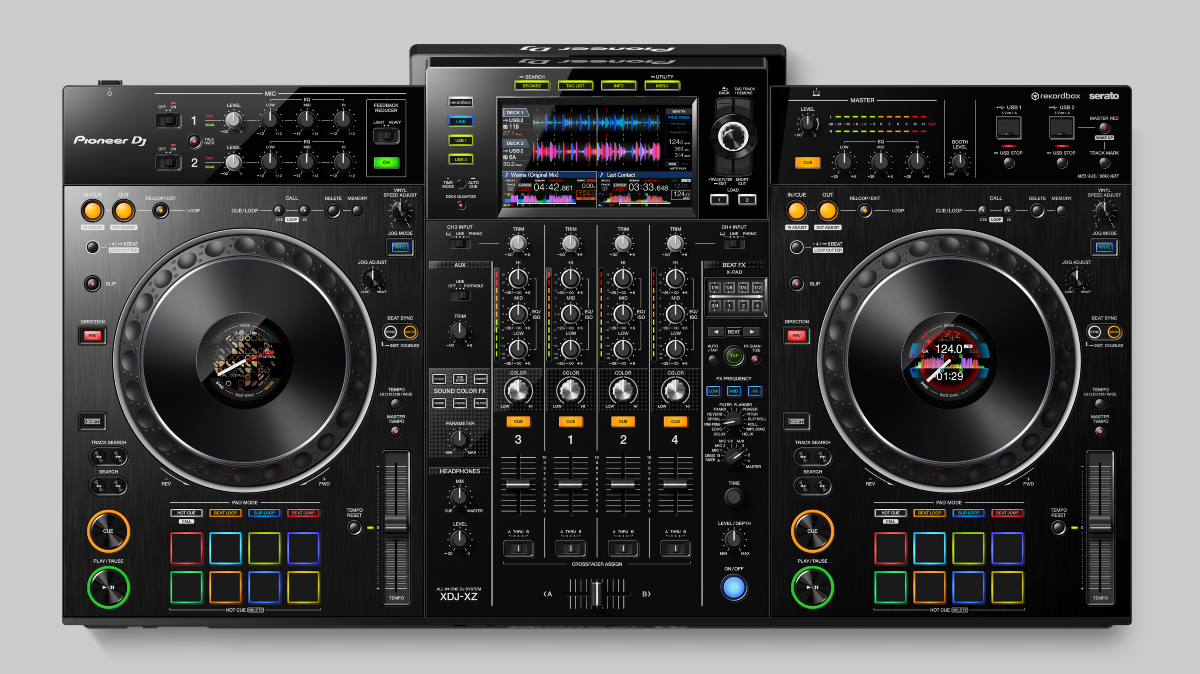
XDJ-XZ (2019) – The next step

XDJ-XZ

“Before XDJ-XZ, we had developed XDJ-RX and RX2 as two-channel, two-deck products,” says Yuji Murai. “As mentioned earlier, they served as a bridge between controllers and separate equipment. But when it came to four channels or big jog wheels…there was concern about cannibalization against separate products, so we did not move into that area for a while.

However, the RX successfully captured demand among DJs using USB memory, and that customer group grew very rapidly. From XDJ-RX onward, the products were hits to the point that they repeatedly exceeded our planned volumes. 

The controller market was also growing, but after we released a system like XDJ-RX, it became a product that contributed not only to our company but also to expanding the DJ industry itself. At the same time, top CDJ models were becoming more advanced. The required specifications kept rising in terms of role, reliability, sound quality and supported media.

“In the past, someone playing in front of 1,000 people might have been considered a top DJ, but with the EDM boom, more DJs were playing in front of much larger audiences. As the role of top DJs became more significant, top models also had to carry greater responsibility.

“As a result, the role of all-in-one units, and their role as a bridge, also needed to move higher. Initially there was concern that four-channel models would compete with separate products, but as the DJ market expanded both upward and outward, there was increasing reason for an all-in-one unit to satisfy higher-level needs.

I think XDJ-XZ was proposed in response to that need emerging from the market.

In terms of technical challenges, there was the fact that it was a four-channel mixer, and that we wanted users to be able to connect two turntables or their own CDJs and mix on channels 3 and 4.

On the other hand, it seems like it should have been possible to play four decks simultaneously from a single USB drive. But at the time, only two decks could be played from the unit itself. Half of that was a technical issue, and frankly, the other half was that we were partly concerned about cannibalization with separate products.

“We had to fit two industry-standard products, the CDJ-2000NXS2 and DJM-900NXS2, into a single all-in-one chassis. But we could not simply make the product size larger without limit, so there was a real challenge in fitting everything into a constrained product size.

Ideally, we would have liked every element to fit at the same size. We also wanted to use the same button sizes as the CDJ-2000NXS2. But due to chassis-size constraints, some buttons had to be smaller.

“There were many difficulties in fitting in all the necessary functions. The internal board structure, which cannot be seen from the top surface of the product, was also very difficult. There was a great deal of space-saving work that had not been necessary with separate products.

“We wanted users to be able to DJ with a feeling as close as possible to the equipment installed in venues.”

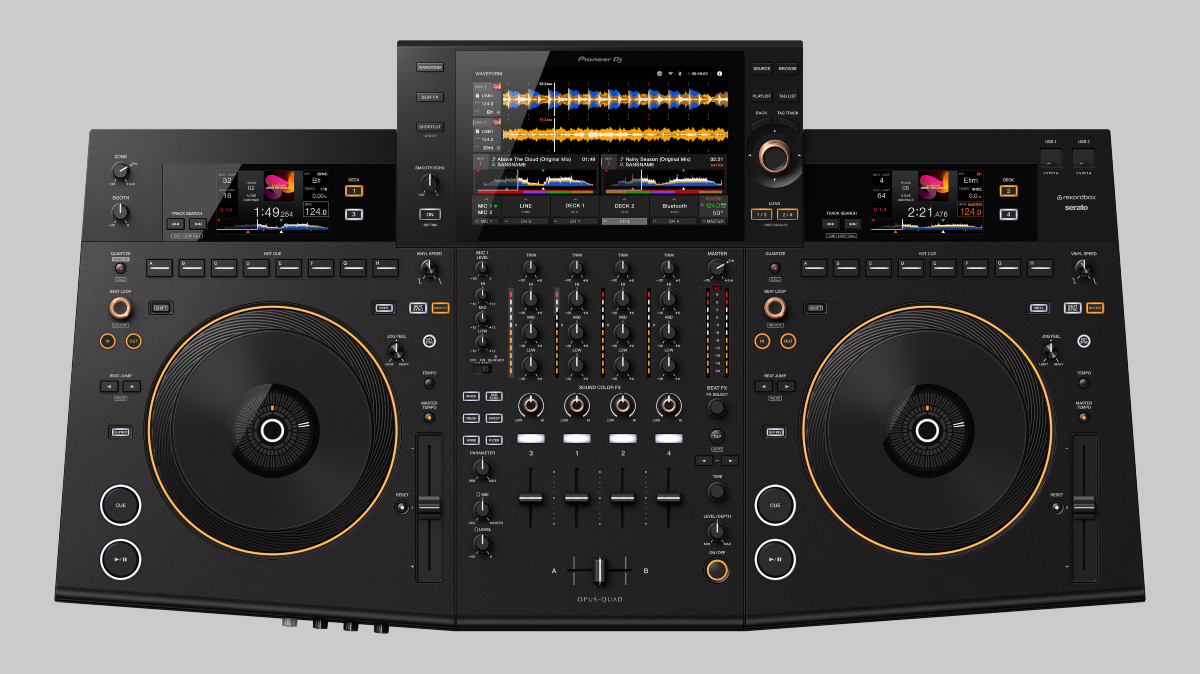
OPUS-QUAD (2023) – New design vibes 

OPUS-QUAD

“At the time, the XDJ-XZ had been received very well in the market, and it had already been decided that XDJ-AZ would be released as its successor,” says Shunsuke Ootani, product planner for the OPUS-QUAD. “Therefore, the XDJ-AZ was positioned as the successor to XDJ-XZ, inheriting and developing the value of an all-in-one DJ system close to professional use.

“For the OPUS, on the other hand, the key planning intention was to present a different value from the XDJ-XZ / XDJ-AZ successor line. Because AZ was going to enter the market as the successor to XZ, OPUS, while also an all-in-one DJ system, needed to avoid being seen as a simple spec competition or successor model. It needed to present a different usage vision, a different world view, and a different user experience.

“In other words, the planning intention behind OPUS was to propose a DJ experience that included new installation environments, lifestyle, and design value, separately from the professional-oriented value established by XDJ-XZ.

“The customer for the OPUS was not the DJ who expresses themselves in a club, but rather the DJ who responds to requests. Simply put, it was aimed at mobile DJs.

Therefore, rather than being an all-in-one that inherits the club-standard manners of the traditional XDJ / CDJ-DJM line, I think the direction was to solve the issues faced by mobile DJs and general DJs working outside clubs: reliability, preparation until the last minute, handling requests, and quick cueing or switching. The approach was to combine the reassurance of standalone hardware with the convenience of network media.”

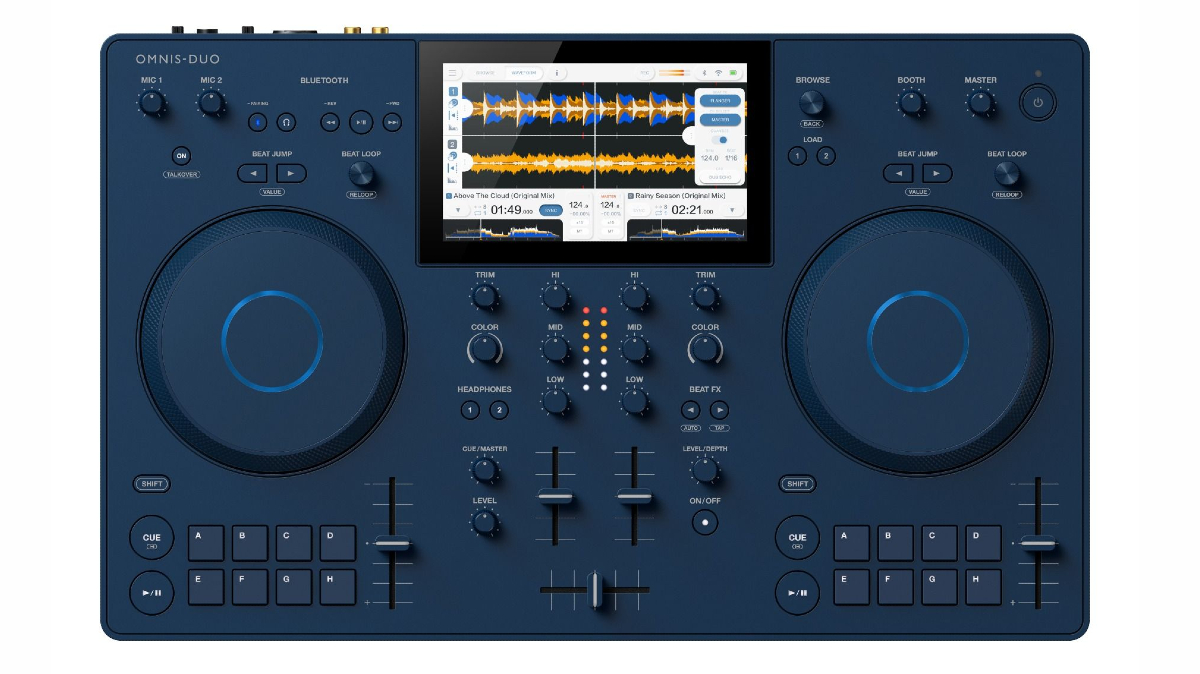
OMNIS-DUO (2024) – Play anywhere

OMNIS-DUO

“For the OMNIS-DUO concept, there was a background in the discussion around RX3,” says Atsuki Yamamoto, product planner for the XDJ-RX3 and OMNIS-DUO. “RX3 was mainly about conveying the philosophy of the flagship product, so it could not fully focus on use cases such as camping or outdoor environments.

“With OMNIS-DUO, there was an intention to cultivate new customers and make DJing feel more familiar. There was also an intention to bring in people who had previously only listened to music.

“We did not want DJ performance to be limited to nightclubs. We wanted to expand it and make it more familiar. The concept of enjoying a DJ party with friends anywhere came from that thinking.

“The difficult points were wireless operation and the battery. This was the first time we had included those features. Batteries are classified as dangerous goods, so export-related processes and approvals were difficult. It was a product with many new elements.

“The design, layout, color, and form were different from existing products. Since thinking based on nightclubs was deeply rooted inside the company, there was some resistance. It was a product that challenged us without precedent.

“It was also the first product released under the AlphaTheta brand, and we had to decide how to show the logo through discussion, without existing know-how. I think the highly innovative aspects of the product also had a strong affinity with AlphaTheta.”

XDJ-AN (2026) – Everyday DJing

XDJ-AN

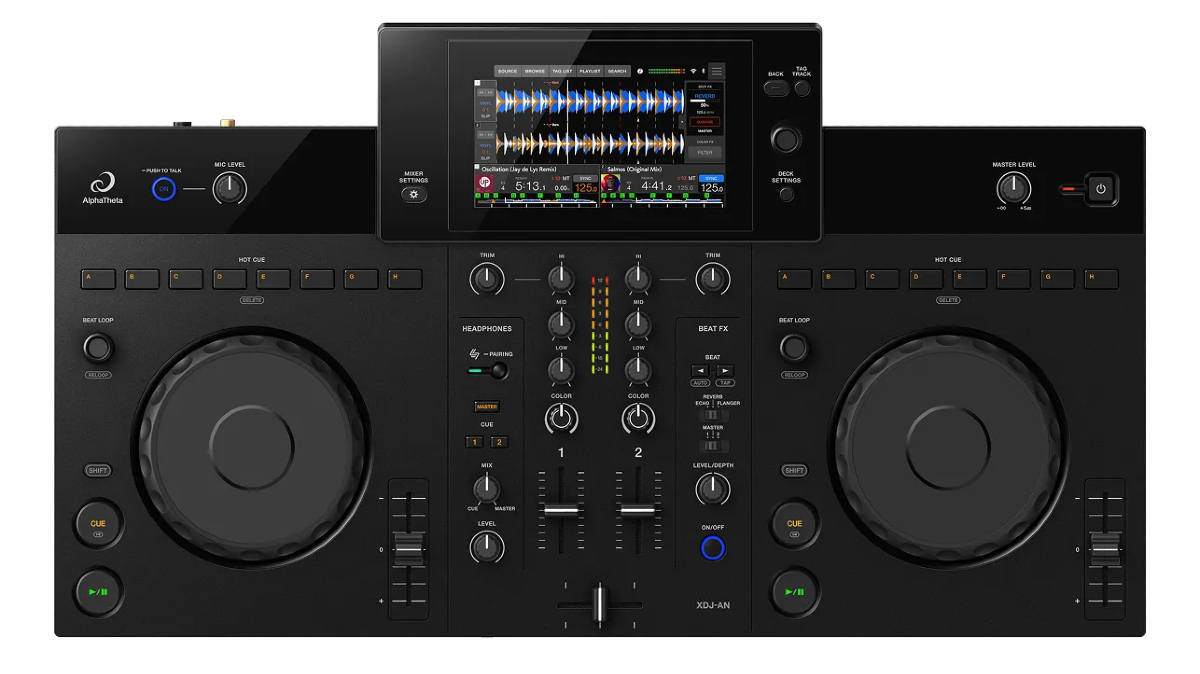
“In terms of XDJ-AN’s positioning within AlphaTheta’s all-in-one lineup, it’s an entry-level model,” says Tokihide Sakoda, product planner for the XDJ-AN. “It has a strong character as a machine for using at home: something that lets users enjoy DJing every day while also preparing for venue play. 

“It’s designed for hobby DJs, broadly divided into two groups. The first group is users who started DJing on a controller and want an all-in-one in order to step up toward venue play.

“The second is a group that seems to have expanded rapidly during the COVID period: people who started DJing on a controller, but who are not primarily focused on stepping up, and instead want to enjoy DJing more as an everyday hobby. The image is that when they get home, they can turn the power on and start DJing immediately, without having to launch rekordbox on a PC every time.

“The media evolution is that Wi-Fi support enables the use of streaming and cloud services. While supporting conventional USB play and PC control, it also enables control via a smartphone app. We are also conscious of bringing in smartphone DJ users.

“The setup evolution is that the built-in SonicLink module makes wireless headphone monitoring usable as a standard experience. With SonicLink headphones, users can turn on the power and start DJing right away, and they can move around while wearing the headphones.

“Another first is support for DJM-REC, making DJ recording and social media streaming from an all-in-one even easier.

“Going forward, by making use of a simple and easy-to-use UI and the ability to DJ easily with streaming, we want to consider initiatives that not only serve as a step up from controller + rekordbox, but can also become an entry point for people to start DJing.”

The XDJ big picture

“Overall, the position of XDJ all-in-one DJ systems changes a great deal with each era,” says Yuji Murai. “The role assigned to each model, the impact on the market and the spread of customers are different between the first AERO and today’s models. They may look similar, but in fact they are different. It is a product format with a very high degree of variability.

“Every model requires a lot of thought about its concept. We need to consider what role it should play between controllers and separate equipment, and within the entire lineup.

“There is real difficulty in deciding what character each individual model should have. I think the effort we put into finding the best optimization for each product reaches customers and earns their trust. These are not products made casually or easily. With every model, we face new questions, overcome them, and reflect the answers in the product.”

Text: Ryan Keeling