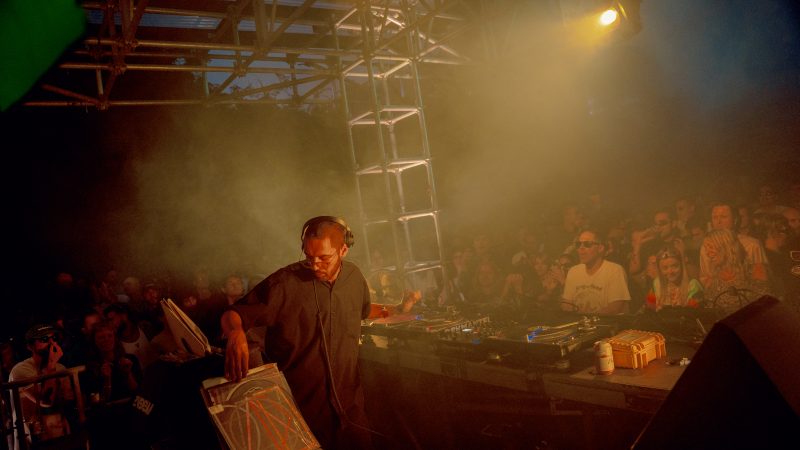
Tell me about your choice of mixer.
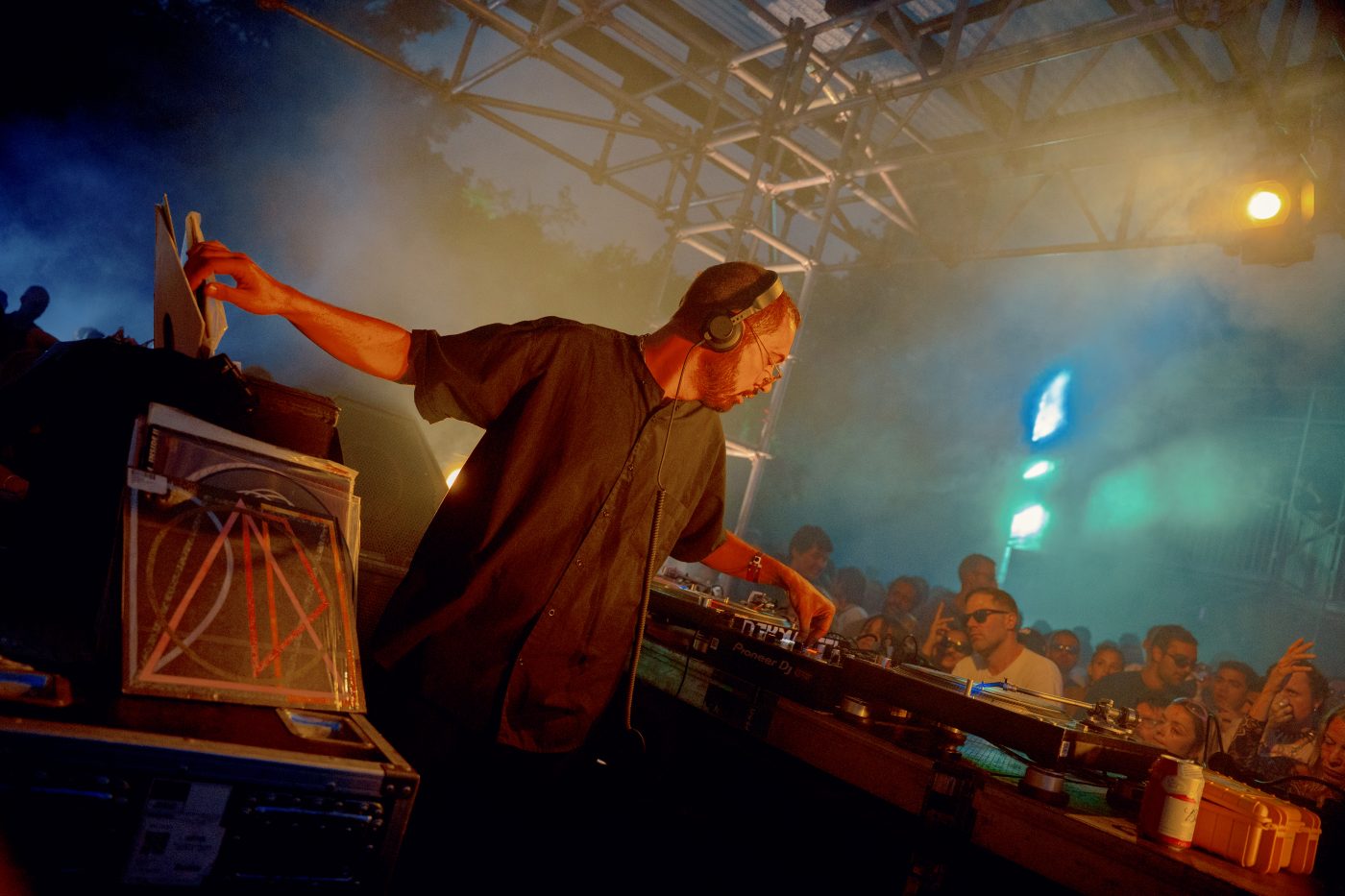
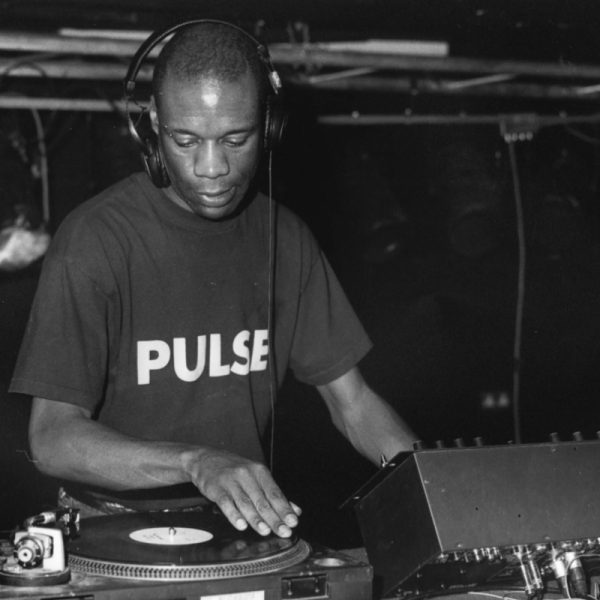
I exclusively use Pioneer DJ for mixers. It’s a crossfader thing. The Pioneer has a great crossfader. I’ve been using the DJM-A9. That’s specified on my rider at the moment. With the other DJMs, I’ve just gone through the evolution really, and I’ve generally been using whatever’s the latest one.
Now we’ve got the V10, this is a whole other interesting thing. Oh, the only exception to that is when they started taking out phono from some channels. So there are some models that don’t have phono all the way along the channels. So the V10 is a little bit of a problem there. I’ve been doing these back-to-backs with Skee Mask where he’s on the right with three, or sometimes two, CDJs, and then I’m on the left with my three turntables. But we can’t assign the three turntables to one, two, and three. They have to be one, three, and five. So we have to label it all up because it’s not in order of how they’re laid out on the table, which is a nightmare.
But I really like the V10, particularly for back-to-backs. The dual cueing is amazing, and that is really important. That’s just changed back-to-backs. I don’t like the idea of it’s your turn, my turn. We can just play at the same time, can’t we?
Like with what I was talking about with modular, frequency mixing—I’ll handle the bass and you handle the tops or whatever. If you’re mixing like that, you don’t have to take it in turns. You can just be doing different parts of what’s going on. It’s a bit more like a live jam. I’ve done some wicked sets where we’re just flowing, we’re both just on the entire set.
I wanted to ask you about FX. It seems like delays are a massive part of what you do. Would that be fair?
Yeah, it would. It varies and there are sometimes technical reasons why I might use a lot of delay, because I’m struggling with one of the turntables or something like that. Or I’m having a lot of situations where I’m missing cues because the needle’s jumping and then I’m having to do really quick mixes and the delay really helps with that.
I love it, though. I love dub and I love the sound of those delays and just being able to complement the tunes like that, it’s super useful. I’ve been using the looping Roll FX in some mad creative ways. I’ve been using it texturally, like having quite textural stuff and just using it to break that up. Kind of like scratching atmospheres but not using the crossfader; it gives a crossfader-y sound because it jumps in and out. I’m going deep on that at the moment.
Let’s talk about your DJ-Kicks mix. How did you approach the project?
So because of the various technicalities of how the mix has to be put together as a compilation and so on, it’s not a start-to-finish DJ mix that happened one day. It’s a crafted album that I’ve put together in the studio involving recordings of me mixing on vinyl. And I’m putting it together as an album that exists as a mix. I’ve approached it as an album. Have you listened to it?
Yes, it’s fantastic.
Oh, thank you. I really wanted it to have a lot of the character of my vinyl DJ sets as well as the character of my productions. I’ve always felt a sort of a disconnect between who I am as a producer, the way I am in the studio, versus who I am as a DJ in clubs. And people are often surprised when they’ve heard my productions and then they come and see me play and it’s quite different. It’s a lot more club-focused, and it’s not necessarily what you’d expect. I don’t play my own stuff often enough, for sure. I should play it more, actually. Anyway, the DJ-Kicks is a real opportunity to put together something that bridges the gap a bit between those two quite different things, particularly as it’s an opportunity to put exclusive tracks in and there, three or four tracks that I’ve composed specifically for the mix.
In the last few years, I’ve really gotten a name for myself as a DJ, and I was like, Oh shit, if I go all the way to the production side of things for DJ-Kicks, I think I might disappoint some people that are interested in me as a vinyl DJ. And so I wanted to bring both together. I recorded a bunch of takes of me doing vinyl mixes. With the way it works, you have to pick out all the tunes first and make sure you can get the licence for them, and so I tried to treat that process a bit like packing a record bag.
I worked with what I had, did a bunch of mixes, recorded them, took them into the studio, slotted in the tunes that were exclusives or not on vinyl yet, that kind of thing. And then I went back and forth a couple of times—OK, now I’ve got a better idea of the mix, now I’m going to rerecord some different stuff. And I did the overdubs and stuff like that.
I think some people have this idea that an approach like that is kind of cheating—you shouldn’t mix vinyl with production techniques. But for me, I wanted to tell a certain story and wanted it to sound a certain way. Thinking like that, I would have put a restriction on myself. I feel I’ve proven myself as a DJ in other ways. In terms of vinyl, I don’t feel the need to kind of show off, “Oh, I did this in one take.”
If you want to see me in one take, watch a video. Come and see me live. That’s me in one take, and there’s plenty of opportunities for that. This is a studio album. You’re not seeing me do it. You’re not witnessing a moment. This is about telling a certain story and creating a narrative and exploring a sound world.